
 Contact

キャプティブ 2025.12.09
CA81 昨夜、12月8日発生した「青森県東方沖地震」の意味
目次
Copyright © Shinichiro Hatani 2025 All rights reserved
For those who prefer to read this column in English, the Japanese text is followed by a British English translation, so please scroll down to the bottom of the Japanese text.
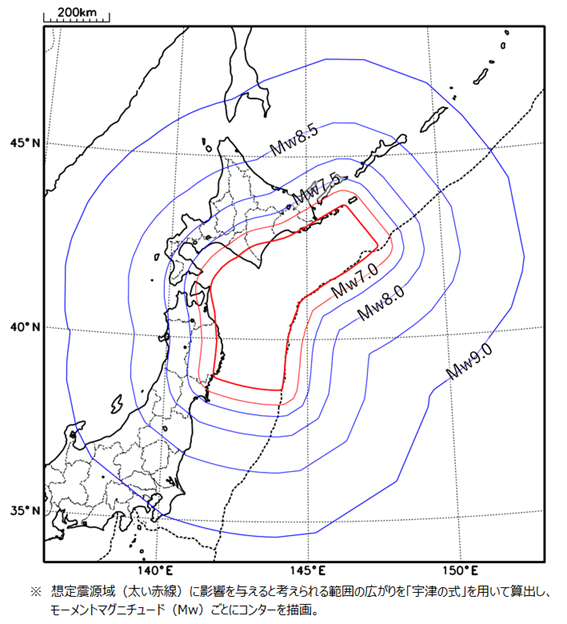
出典:「気象庁」の「公式ウエブサイト」
「『北海道・三陸沖後発地震注意情報」の発表基準と情報発表の流れ』
『北海道・三陸沖後発地震注意情報』の発表基準」より
| 「モーメントマグニチュード(Mw)」とは、一般的に使用されているマグニチュードと異なり、「震源断層のずれの規模を精査して得られるマグニチュード」のことである。 |
「キャプティブ」は、「地震リスクに対するリスクマネジメント・ツールとして大きな役割を果たす存在」であるが、地震リスクの規模が大きければ大きいほどその効用は高く大きくなる。
損害額、被害額が大きくなり、直接的な被害のみならずインフラが受ける被害も大きくなり、企業業績回復への足枷になるリスクが高くなるという事態に対応できる、キャプティブによって、日本の損保では補えない十分な補償額を海外の巨大な再保険会社から得ることが可能になるからである。
南海トラフ大地震と同様、非常に危惧されている地震は、政府中央防災会議が2021年12月21日、被害想定を発表した「日本海溝・千島海溝沿いの大地震 」である。
「千島海溝の17世紀型」と言われ、地震規模の想定は「マグニチュード8.8以上」であり、同報告の中で「地震の発生確率が高く30年以内の地震発生率が26%以上」とされている地震である。
「千島海溝の17世紀型」とは、津波堆積物の調査から、太平洋プレートが北米プレートの下に沈み込んでいる千島海溝で17世紀に起きた巨大地震のことを言う。それ以前にも、300~400年の周期で大津波を伴う巨大地震が千島海溝では発生していた。一方、日本海溝で起きた巨大地震の筆頭は、無論、2011年の東日本大震災である。
政府の発表した「令和3年 12 月 21 日」付「中央防災会議 防災対策実行会議 日本海溝・千島海溝沿いの巨大地震 対策検討ワーキンググループ」の被害想定資料の冒頭(総括)より、抜粋引用する。
本被害様相は、日本海溝・千島海溝沿いの巨大地震で発生する可能性のある事象を積雪寒冷地特有の事象も含め、東日本大震災の被災状況や復旧推移をもとに、一部、阪神・淡路大震災での状況を踏まえて想定したものである。被害の様相は、地震による強い揺れや津波の発生状況により異なるが、全国の状況で用いた数値は、日本海溝モデルと千島海溝モデルの 2 ケースの最大値を表記している。
「日本海溝モデル」、つまり震源が日本海溝の場合、北海道の沖合から岩手県沖にかけてM9.1の巨大地震が発生、岩手県宮古市では29.7mの大津波が発生すると想定している。地震の発生時期、住民の避難状況から、6つのシナリオを想定しているが、冬の深夜に地震が起きた場合には、住民の早期避難も難しいため、犠牲者は北海道で13万7千人、青森県4万1千人、岩手県1万1千人、宮城県8500人、他県も合わせて合計19万9000人と推定、経済被害は31兆3千億円に及ぶと推計している。
「千島海溝モデル」では北海道襟裳岬の東沖合を震源域と想定している。このモデルでは、日本海溝モデルよりも地震の規模は更に大きく東日本大震災を上回るM9.3の地震が発生するとしている。この巨大地震によって、最大で27.9mの大津波が押し寄せ、犠牲者は北海道で8万5千人、他県も含めて合計で10万人と推定、経済被害は16兆7千億円に及ぶと推定するものである。
甚大な被害を引き起す「日本・千島海溝巨大地震」が、30年以内に26%以上の確率で地震が発生するという被害予測を国が出している、果たしてその「備え」は十分であろうか。

1.青森県東方沖の地震
昨夜、ロンドンとの交信を終えて、床に就こうと思った際、椅子が揺れた。「あれ?」と思って窓際のカーテンを見ると揺れていた、「地震だ」とTVをつけると、速報が流れていた。
「気象庁の公式ウエブサイト」の「令和7年12月8日23時15分頃の青森県東方沖の地震について」には、以下が記されている。
| 地震の概要 | |
| 検知時刻 (最初に地震を検知した時刻) | 12月8日23時15分頃 |
| 発生時刻 (地震が発生した時刻) | 12月8日23時15分頃 |
| マグニチュード | 7.6(速報値) |
| 発生場所 | 青森県東方沖(八戸の東北東80km付近) 深さ約 50km |
| 震度 | 【最大震度6強】青森県の八戸市(はちのへし)で震度6強を観測したほか、北海道から近畿地方にかけて震度6弱~1を観測 |
| 地震活動の状況 (9日00時30分現在) | 今回の地震発生後、震度1以上を観測した地震が3回発生(震度3:1回 震度1:2回) |
| 長周期地震動の観測状況 | 青森県三八上北で長周期地震動階級3を観測 |
典型的なプレート境界型地震である。海側の太平洋プレートが、陸側の北米プレートに沈み込み、陸側プレートがそのひずみに耐えられずに跳ね上がることで発生したものと考えられる。
そして、重要なことは、昨夜の地震(冒頭の図の「想定震源域(太い赤字)」)は、2021年に公表された下図、「主な海溝型地震の評価結果」(政府 地震調査研究推進本部)」にある場所「青森県東方沖から岩手県沖南部」、大きさ「M(マグニチュード)7~7.9程度」とピタリ符合するということである。
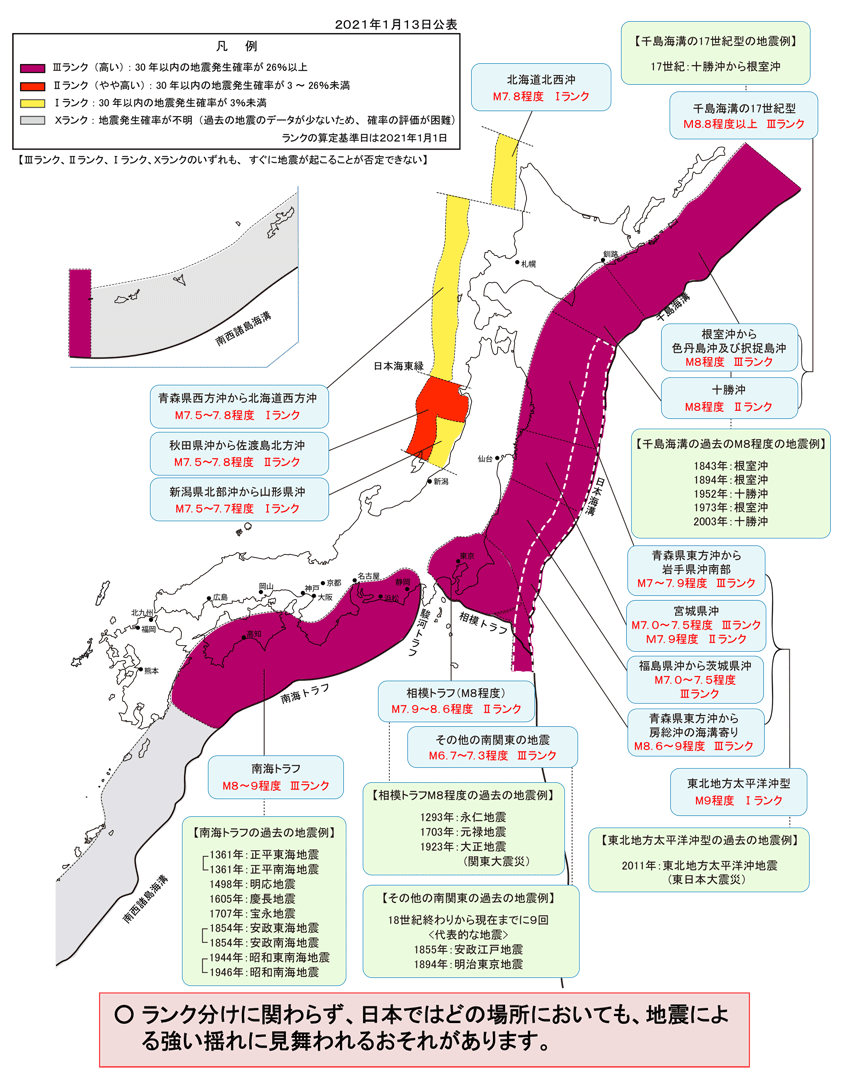
出典:「主な海溝型地震の評価結果」(政府 地震調査研究推進本部)
2.地震の種類
地震の分類手法は様々にあるが、一般的には発生原因によって大きく二つに別けられる。
複数のプレート境界で発生する「海溝型地震」、そして同一プレートの内部にできた断層で発生する「断層型地震」である。
「直下型地震」という名称もよく使用される。居住地域の「直下」で起こる震源の浅い地震のことを指し、その多くは「断層型地震」であるが、地域によっては「断層型地震」ではなく「海溝型地震」として発生することもある。
1923年の関東大震災のように、関東地方南部で繰り返し発生してきたマグニチュード7クラスの大地震は、総称して南関東直下地震と呼ばれているが、これは断層が動いて地震が起きる「断層型地震」ではなく、関東地方の土台である北米プレートに海側のフィリピン海プレートが沈み込んでいる場所、相模トラフで発生する「海溝型地震」である。
3.マグニチュード
地震の大きさは、この「マグニチュード」という指標で表わされているが、マグニチュードの数字が増えることで、どれくらい地震の規模が大きくなるか、地震のエネルギー量が増えるか。
マグニチュード7とマグニチュード8のマグニチュード1の差は、無論「1の差」ではないが、その10分の1の数字、マグニチュード0.1の差であっても、約1.4倍、マグニチュード0.2の差になると約2倍(101.5×0.2 = 100.3 ≒ 1.995)となる。
それが整数、例えばマグニチュード7とマグニチュード8の「1の差」では、マグニチュードの値の増加は測定された振幅の10倍の増加を示した数値とされているので、「マグニチュードが1増えると、10√10 =約30倍、2増えると(10√10)2 = 約1000倍、エネルギー量は増える」のである。
つまりマグニチュード6.0と8.0の地震の規模は、約1000倍違うということである。
また、地震が発生した際、気象庁から発表されるマグニチュードは小数第1位まで発表されている。つまり、「マグニチュード8.0」と発表された場合、その地震の規模は「マグニチュード7.95〜8.05の範囲内にある」と考えられる。
マグニチュード7.95と8.05、たった0.1の差であるが、上記のとおり、マグニチュード0.1の差はエネルギー量では約1.4倍の差、「気象庁の発表の段階」で、「既に地震の規模は最大で約1.4倍の開きがある」のである。
1995年の阪神・淡路大震災は、「六甲・淡路島断層帯」の横ずれによって発生した「断層型地震」(直下型)」であったため、あれほど甚大な被害を出したが、マグニチュードの値は7.3であった。
一方、日本周辺での観測史上最大の地震であった東日本大震災のマグニチュードは9.0であり、そのエネルギー量の差は300倍以上あったということである。プレート境界で発生する「海溝型地震の巨大さ」である。
冒頭記したとおり、こうしたことから、キャプティブは巨大地震である「海溝型地震」に備えようとする企業にとっては、必須の企業戦略、リスクマネジメント・ツールと言われているのである。
今回のまとめ
1.西に南海トラフ大地震、東に日本海溝・千島海溝沿いの大地震、これらのリスク抱える我が国。複数の大陸プレートの上に存在するため、地震とは常に付き合っていかなければならない宿命を抱えている。だからこそ「そのための備え」が必要なのである。
しかし、残念ながら、様々に報道されているとおり、日本企業のリスクマネジメントに対する意識は、一部の先進的な企業を除いて大半の企業では、「起こったら仕方がない」という意識が蔓延しているとしか思えない状況と感じる。
以前のコラムでも引用したが、2023年4月26日付「日本経済新聞」のコラム「保険難民の時代㊥」には、「地震保険、企業の加入率『数%』 」と題した記事のなかで「地震保険加入率」について、次の様に記されていた。(青色、赤色は筆者が付加)
関東大震災から今年で100年。首都直下型地震への警戒が強まっているが、地震保険の加入率は首都圏が低い。損害保険料率算出機構によると、東京都や神奈川県など首都圏の火災保険に地震保険を付帯する割合は60%台前半で、大規模地震を近年経験した宮城県(88.7%)や熊本県(85.3%)を大きく下回る。
企業向けはさらに深刻で「地震保険の加入率は全国で数%程度」(複数の損保関係者)とされる。
スイス再保険の調査によると、日本の自然災害に対する保険カバーは45%にとどまる。2011年の東日本大震災では発生した経済的損失のうち、約2割しか保険でカバーされなかった。当時よりもカバー率が上昇したともいえるが、同年に起きたニュージーランド地震のカバー率(約7割)と比べれば、備えは十分とはいえない。
また、加入率の低さの理由について、以下のように記されていた。
ひとつの理由は損害保険会社が積極的に販売していないことだ。個人地震保険は政府が12兆円まで負担するが、企業地震保険はこの仕組みがなく、グローバルな再保険市場を頼るしかない。ある損保関係者は「リスク許容量に限界があり、得意先や系列企業に優先的に提供しているのが実態」と話す。
2.政府の地震調査研究推進本部が公式に表明しているとおり、「近い将来、甚大な被害をもたらす可能性のある大地震発生の可能性は高い」。
しかし、地震保険の加入率は低いままである。その理由はどこにあるのか。ひとえに「保険料が高い」と見なされているからであろう。
首都圏では、個人保険分野の地震保険でも、主契約である火災保険料の約4倍から5倍の保険料になる。しかし、この地震保険料は何も根拠も理由も無く決定されたものではなく、「リスク応分の保険料」なのである。
3.企業保険分野の地震保険の保険料も同様である。グローバル・リンクがキャプティブの設立コンサルティングをおこない、その運営管理を任されている例でも、保険金額800億円に対して主契約である火災保険料は2000万円、これに対して地震保険料は2億8000万円、10倍以上の差である。
もし、この地震保険料が「掛け捨てのまま」であれば、果たして地震保険を購入されたであろうか。答えは「否」であった。
「キャプティブの設立によって、実質的な地震保険コストが安くなったから購入の決断をした」というのがその顧客の地震保険購入の理由であったからである。
4.更に、「国難」とも思える巨大地震が発生した際の我が国の状況を考えると、「リスク・ヘッジの担い手を海外に置くことの重要性」が際立つのではないだろうか。
キャプティブを設立することは、世界最大級の海外の再保険会社がキャプティブからの再保険を引受けること、つまり、世界最大級の海外の保険会社が地震リスクを引受けるということである。
しかも、上記の例では、その世界最大級の海外の保険会社が実質的にそのリスク全体をほぼ引受ける保険料、つまり「キャプティブからの再保険料」は8000万円である。結果、「2億8000万円の保険料全額が掛け捨てにならず」に、そこで生まれた「内外価格差」によって毎年2億円あまりが「キャプティブの収益」となるプログラムとなったのである。
政府 地震調査研究推進本部が発表している「地震予測」と「場所、大きさ」が符合する地震が昨夜が起きた。この地震を「天の啓示」と捉えるか、それとも「いつもあること」と見過ごすか、それによって「まさかの時」には大きな違いが出てくるであろう。
執筆・翻訳者:羽谷 信一郎
English Translation
Captive (CA) 81 – The Significance of the Earthquake Occurring Off the Eastern Coast of Aomori Prefecture last night, 8 December
Captives play a significant role as risk management tools for earthquake risk, with their utility increasing in proportion to the scale of that risk.
This is because they enable the acquisition of sufficient coverage from major overseas reinsurance companies – coverage that Japanese non-life insurers cannot provide – to address situations where damage and loss amounts become substantial, where not only direct damage but also infrastructure damage increases, and where the risk of hindering corporate recovery becomes heightened.
Alongside the Nankai Trough earthquake, another highly feared seismic event is the ‘Major Earthquake along the Japan Trench and Kuril Trench’, for which the Central Disaster Prevention Council released damage projections on 21 December 2021.
This is termed the ‘17th-century type along the Kuril Trench’, with an estimated magnitude of ‘8.8 or greater’. The report states it has a ‘high probability of occurrence, with a 26% or greater chance of happening within the next 30 years’.
The ‘17th-century type Kuril Trench earthquake’ refers to a massive earthquake that occurred in the 17th century along the Kuril Trench, where the Pacific Plate subducts beneath the North American Plate, as indicated by tsunami deposit investigations. Prior to this, massive earthquakes accompanied by large tsunamis had occurred in the Kuril Trench at intervals of 300 to 400 years. Meanwhile, the foremost massive earthquake to occur along the Japan Trench is, of course, the 2011 Great East Japan Earthquake.
The following is an excerpt from the opening summary of the damage estimation materials published by the government on 21 December 2021, from the ‘Working Group on Countermeasures for Major Earthquakes along the Japan Trench and Kuril Trench’ under the Disaster Prevention Measures Implementation Conference of the Central Disaster Prevention Council.
This damage scenario is based on events likely to occur during a major earthquake along the Japan Trench and Kuril Trench, including phenomena specific to snow-covered cold regions. It is modelled on the damage situation and recovery progress of the Great East Japan Earthquake, with some aspects also considering the situation during the Great Hanshin-Awaji Earthquake. The nature of the damage will vary depending on the intensity of the seismic shaking and the tsunami generation. The figures used for the nationwide assessment represent the maximum values from two case models: the Japan Trench Model and the Kuril Trench Model.
The ‘Japan Trench Model’ assumes a magnitude 9.1 mega-earthquake occurring offshore from Hokkaido to Iwate Prefecture, with a 29.7-metre tsunami expected to strike Miyako City, Iwate Prefecture. Six scenarios were considered based on the earthquake’s timing and the evacuation status of residents. If the earthquake occurred in the dead of winter, prompt evacuation would be difficult. Consequently, the estimated casualties are 137,000 in Hokkaido, 41,000 in Aomori Prefecture, 11,000 in Iwate Prefecture, 8,500 in Miyagi Prefecture, and a further 199,000 across other prefectures. The estimated economic damage amounts to ¥31.3 trillion.
The “Kuril Trench Model” assumes the epicentre lies east of Cape Erimo, Hokkaido. This model predicts an even larger earthquake than the Japan Trench Model, exceeding the Great East Japan Earthquake with a magnitude of M9.3. This mega-earthquake would generate a tsunami reaching heights of up to 27.9 metres. Casualties are estimated at 85,000 in Hokkaido and a total of 100,000 including other prefectures, with economic damage estimated at ¥16.7 trillion.
The government has issued a disaster forecast indicating a greater than 26% probability of the ‘Japan-Kuril Trench Mega-Earthquake’ – which would cause catastrophic damage – occurring within the next 30 years. Is our preparedness truly sufficient?
1. Earthquake off the Eastern Coast of Aomori Prefecture
Last night, having finished communications with London and just as I was about to retire for the night, my chair began to shake. ‘Huh?’ I thought, glancing at the curtains by the window which were also swaying. ‘An earthquake,’ I realised, switching on the television to find breaking news reports already airing.
The ‘Japan Meteorological Agency’s Official Website’ under ‘Regarding the Earthquake Off the Eastern Coast of Aomori Prefecture around 23:15 on 8 December 2025’ states the following:
Earthquake Overview
Detection Time (Time the earthquake was first detected) Around 23:15 on 8 December
Occurrence Time (Time the earthquake occurred) Around 23:15 on 8 December
Magnitude 7.6 (Preliminary value)
Location Off the east coast of Aomori Prefecture (approximately 80 km northeast of Hachinohe) Depth Approximately 50 km
Intensity [Maximum Intensity 6 Upper] Intensity 6 Upper was observed in Hachinohe City, Aomori Prefecture. Intensity 6 Lower to 1 was observed from Hokkaido to the Kinki region.
Status of Seismic Activity (as of 00:30 on the 9th) Since this earthquake occurred, three earthquakes with intensity 1 or higher have been observed (Intensity 3: 1 occurrence, Intensity 1: 2 occurrences).
Long-period seismic motion observation status
Long-period seismic motion class 3 observed in Sanboku Kamikita, Aomori Prefecture
This is a typical plate boundary earthquake. It is thought to have occurred when the Pacific Plate subducted beneath the North American Plate, causing the overriding plate to rebound as it could no longer withstand the accumulated strain.
Crucially, last night’s earthquake (the ‘assumed epicentre area [thick red line]’ in the opening diagram) precisely matches the location ‘off the eastern coast of Aomori Prefecture to the southern coast of Iwate Prefecture’ and magnitude ‘approximately M (Magnitude) 7 to 7.9’ indicated in the diagram below, ‘Evaluation Results of Major Trench-Type Earthquakes’ (Government Headquarters for Seismic Research Promotion), published in 2021.
Source: “Evaluation Results of Major Trench-Type Earthquakes” (Government Headquarters for Earthquake Research Promotion)
2. Types of Earthquakes
While various methods exist for classifying earthquakes, they are generally divided into two main categories based on their cause.
These are “trench-type earthquakes”, which occur at multiple plate boundaries, and “fault-type earthquakes”, which occur along faults formed within the same plate.
The term ‘direct-hit earthquake’ is also frequently used. This refers to shallow-focus earthquakes occurring directly beneath populated areas. While most are ‘fault-type earthquakes’, in certain regions they can occur as ‘trench-type earthquakes’ rather than fault-type.
The magnitude 7-class major earthquakes that have repeatedly struck the southern Kanto region, such as the 1923 Great Kanto Earthquake, are collectively termed the South Kanto Direct-Hit Earthquakes. These are not ‘fault-type earthquakes’ caused by fault movement, but rather ‘trench-type earthquakes’ originating in the Sagami Trough. This is the location where the Philippine Sea Plate subducts beneath the North American Plate, which forms the foundation of the Kanto region.
3. Magnitude
The size of an earthquake is expressed by this metric, “magnitude”. But how much larger does the earthquake become, or how much greater is its energy, as the magnitude number increases?
The difference between magnitude 7 and magnitude 8 is, of course, not merely a “difference of 1”. Even a difference of magnitude 0.1 (one tenth of a magnitude) represents approximately a 1.4-fold increase. A difference of magnitude 0.2 equates to approximately a twofold increase (101.5×0.2 = 100.3 ≒ 1.995). When this is an integer difference, such as the “difference of one” between magnitude 7 and magnitude 8, the increase in magnitude value represents a tenfold increase in the measured amplitude. Therefore, “an increase of one magnitude corresponds to an increase of approximately 30 times (10√10), and an increase of two magnitudes corresponds to approximately 1000 times (10√10)² the energy released”.
In other words, the scale of an earthquake measuring magnitude 6.0 differs by approximately 1000 times from one measuring magnitude 8.0.
Furthermore, when an earthquake occurs, the magnitude announced by the Japan Meteorological Agency is given to one decimal place. Thus, if an earthquake is announced as ‘magnitude 8.0’, its scale is considered to lie within the range of ‘magnitude 7.95 to 8.05’.
The difference between magnitudes 7.95 and 8.05 is merely 0.1. However, as noted above, a 0.1 magnitude difference equates to approximately 1.4 times the energy released. At the stage of the JMA’s announcement, the scale of the earthquake is already potentially up to 1.4 times greater.
The 1995 Great Hanshin-Awaji Earthquake was a ‘fault-type earthquake’ (directly beneath the city) triggered by a strike-slip movement along the ‘Rokko-Awaji Island Fault Zone’. This caused such extensive damage, yet its magnitude was 7.3.
In contrast, the Great East Japan Earthquake, the largest earthquake ever recorded in the history of observations around Japan, had a magnitude of 9.0. This means the difference in energy released was over 300 times greater. This is the sheer magnitude of trench-type earthquakes occurring at plate boundaries.
As noted at the outset, this is why captive insurance is considered an essential corporate strategy and risk management tool for companies seeking to prepare for massive trench-type earthquakes.
Summary of this issue
1. Our nation faces the risks of a major Nankai Trough earthquake to the west and a major earthquake along the Japan Trench and Kuril Trench to the east. Existing atop multiple continental plates, it bears the fate of having to coexist with earthquakes. Precisely for this reason, ‘preparation for such events’ is necessary.
Regrettably, however, as widely reported, the awareness of risk management among Japanese companies seems, with the exception of a few advanced firms, to be pervaded by a mindset of ‘if it happens, it happens’ among the majority.
As cited in a previous column, the 26 April 2023 Nikkei column “The Era of Insurance Refugees ㊥” included an article titled “Earthquake Insurance: Corporate Subscription Rate ‘Several Percent”’. It stated the following regarding “earthquake insurance subscription rates”:
This year marks 100 years since the Great Kanto Earthquake. While vigilance against a direct-hit earthquake in the capital is heightening, earthquake insurance subscription rates remain low in the metropolitan area. According to the Damage Insurance Rate Calculation Organisation, the proportion of fire insurance policies in the capital region, including Tokyo and Kanagawa Prefecture, that include earthquake insurance add-ons is in the low 60% range. This is significantly lower than in Miyagi Prefecture (88.7%) and Kumamoto Prefecture (85.3%), which have experienced large-scale earthquakes in recent years.
The situation is even more severe for businesses, with ‘earthquake insurance enrolment rates nationwide estimated at around a few percent’ (according to multiple non-life insurance industry sources).
According to a Swiss Re survey, insurance coverage for natural disasters in Japan stands at just 45%. During the 2011 Great East Japan Earthquake, only about 20% of the resulting economic losses were covered by insurance. While coverage has increased since then, it remains insufficient compared to the coverage rate (around 70%) for the New Zealand earthquake that occurred the same year.
The reasons for the low uptake were outlined as follows:
One reason is that non-life insurers are not actively selling it. While the government subsidises personal earthquake insurance up to ¥12 trillion, no such mechanism exists for corporate earthquake insurance, leaving companies reliant on the global reinsurance market. One non-life insurer source stated, ‘There are limits to risk capacity, and the reality is that coverage is prioritised for key clients and affiliated companies.’
2. As officially stated by the Government’s Headquarters for the Promotion of Earthquake Research, ‘the possibility of a major earthquake occurring in the near future, with the potential to cause extensive damage, is high.’
However, the uptake rate for earthquake insurance remains low. Where does the reason lie? It is likely perceived simply as ‘the premiums are too high.’
In the Greater Tokyo Area, even for personal earthquake insurance, the premium can be approximately four to five times that of the main fire insurance policy. However, this earthquake premium is not determined without basis or reason; it is a ‘risk-proportionate premium’.
3. The same applies to earthquake insurance premiums in the corporate insurance sector. Even in cases where Global Link has provided consulting for captive establishment and is entrusted with its operational management, for an insured amount of ¥80 billion, the fire insurance premium for the main policy is ¥20 million, whereas the earthquake premium is ¥280 million – a difference of more than tenfold.
Had this earthquake insurance premium remained a “pure expense”, would the client have actually purchased the earthquake cover? The answer was “no”.
The client’s reason for purchasing the earthquake insurance was precisely that “the establishment of the captive reduced the effective cost of earthquake insurance, enabling the decision to purchase”.
Furthermore, considering Japan’s situation should a massive earthquake occur – one that could be considered a “national crisis” – does this not highlight the importance of placing the burden of risk hedging overseas?
Establishing a captive means that one of the world’s largest overseas reinsurance companies underwrites reinsurance from the captive; in other words, one of the world’s largest overseas insurance companies assumes the earthquake risk.
Moreover, in the above example, the premium – the ‘reinsurance premium from the captive’ – that this world-leading overseas insurer effectively pays to underwrite virtually the entire risk is ¥80 million. Consequently, the entire ¥280 million premium is not entirely forfeited; instead, the resulting ‘domestic-international price differential’ generates over ¥200 million annually as ‘captive revenue’ under this programme.
An earthquake matching the ‘prediction’ and ‘location, magnitude’ announced by the Government’s Earthquake Research Promotion Headquarters occurred last night. Whether one perceives this earthquake as a ‘divine revelation’ or dismisses it as ‘business as usual’ will likely make a significant difference when the ‘unthinkable happens’.
Author/Translator: Shinichiro Hatani