
 Contact

キャプティブ 2026.02.26
CA83 超巨大地震(17世紀型)
目次
- 1.超巨大地震に対してキャプティブが果たす意味
- 2.地震の規模(マグニチュード)
- 3.日本海溝・千島海溝沿いの巨大地震
- 4.「北海道・千島海溝沿いにひずみ蓄積」の報道
- 今回のまとめ
- 1. The significance of captives for mega-earthquakes
- 2. Earthquake Magnitude
- 3. Mega-earthquakes along the Japan Trench and Kuril Trench
- 4. Report on ‘Strain Accumulation Along the Hokkaido-Kuril Trench’
- Summary of this issue
Copyright © Shinichiro Hatani 2026 All rights reserved
For those who prefer to read this column in English, the Japanese text is followed by a British English translation, so please scroll down to the bottom of the Japanese text.
「超巨大地震(17世紀型)」という本コラムの標題に「え、なに?」と思われる方も多いだろう。
この言葉は、1995年1月17日に発生した阪神・淡路大震災の経験を活かし地震に関する調査研究を政府として一元的に推進するために設置された、「地震調査研究推進本部」の公式WEBサイトにある「海溝で起こる地震」のなかで、以下のように説明されているものである。
「北海道東部では津波堆積物(津波によって運ばれた海底や海岸の堆積物)が海岸から離れた湿原の土中や海食崖の上部等で確認され、その解析から17世紀に1952年の十勝沖地震をはるかに超える規模の津波が発生し、現在の海岸線から1~4km程度内陸まで浸水したと推定されています。なお、正確な発生年は定まっておらず、既存の知見から1611年から1637年の間に発生したと評価しました。
これまで、この地震は十勝沖と根室沖の震源域が連動する地震であると評価されてきましたが、その後の研究により、この津波を発生させた地震は両領域が海溝寄りの領域を含んで破壊する平成23年(2011年)東北地方太平洋沖地震と同様の特徴を持ち、規模はMw8.8に達する地震であった可能性が指摘されています。
このような地震は、津波堆積物から17世紀と推定された地震を含め過去6500年間に最多で18回発生したと推定されています。しかし、砂層の数や内陸方向の分布が調査地点によって差があり、推定される地震(津波)の規模や発生時期は不確実性が大きく、必ずしも全ての地震が17世紀と同様の震源域・規模であるとは限りません。根室沖の領域を含む地震である可能性が高いものの、震源域を推定することは困難です。
しかし、北海道東部に巨大な津波が繰り返し来襲したことは事実であることから、包括してひとつの地震の型として評価しました。調査結果により個々の地震の発生間隔は約100~800年とばらつきがあり、平均発生間隔も約330~590年と、様々な推定結果があります。北海道厚岸郡の調査結果を使用すると、平均発生間隔は約340~380年と推定しました。個々の地震の発生時期の不確実性が大きいため、ほかのプレート間巨大地震に比べ平均発生間隔の不確実性が大きくなりますが、より古く、より多くの地震を考慮できています。」
千島海溝沿いの評価対象領域
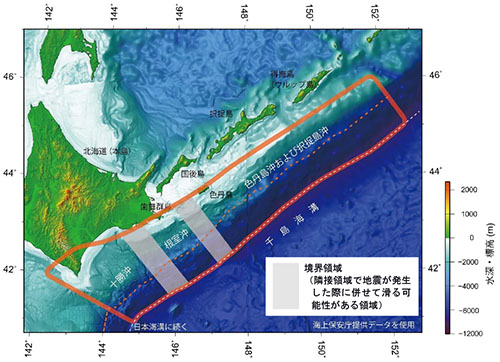
(出典:政府「地震調査研究推進本部」ホームページ)
1.超巨大地震に対してキャプティブが果たす意味
自社専用保険会社「キャプティブ」は、地震リスクに対するリスクマネジメント・ツールとして大きな役割を果たす存在であるが、地震リスクの規模が大きければ大きいほどその効用は高くなると言われている。
その理由は、巨大地震が発生した場合、その損害額、被害額は非常に大きくなることが予想され、日本国内で一般的に日本の国内損害保険会社から調達できる「地震リスクの引受キャパシティ(受容力)を遥かに凌駕する規模となる」からである。海外の巨大再保険会社、再保険市場から、その補償の「ギャップ」を埋め合わせる必要があるからである。
更に、地震の規模が大きくなればなるほど直接的な被害のみならず、インフラが受ける被害は非常に大きくなり、地震から復興しようとする企業にとっては、企業業績回復への大きな足枷になるリスクが高く、「地震リスクへの十分な備え」が必要となるからである。
こうしたことから、キャプティブは巨大地震となる可能性の高い「海溝型地震」に備えようとする企業にとっては、必須の企業戦略、リスクマネジメント・ツールになると言われている。
2.地震の規模(マグニチュード)
これまで、本コラムでたびたび記してきたことであるが、地震による被害想定を検証する際には地震の規模を示すマグニチュード(M)を正確に把握しておく必要がある。
マグニチュードのエネルギーは、0.1の差は単に0.1の差ではなく、約1.4倍の差、0.2の差では約2倍(101.5×0.2 = 100.3 ≒ 1.995)となる。したがって、値が1つ大きくなると地震のエネルギーは約30倍大きくなる。2つ違うと地震のエネルギーは実に約1,000倍(≒30×30倍)、マグニチュードの値が3つ大きくなると地震のエネルギーは約30,000倍(≒30×30×30倍)大きくなる。
地震を大きく分けると「海溝型地震」と「断層型地震」に分けられるが、「海溝型地震」は、地球規模の「プレート」境界で発生するため、「地球規模の巨大な地震」となる可能性が高い。
「断層型地震」であった1995年1月17日の阪神・淡路大震災は、甚大な被害をもたらしたが、地震の規模を示すマグニチュード(M)の値は7.3であった。一方、「海溝型地震」であった2011年3月11日の東日本大震災のマグニチュード(M)は9.0。地震の規模・エネルギー量の差は実に300倍以上であった。如何に海溝型地震が巨大地震化するかが解る数値である。
冒頭記した「千島海溝で発生する可能性のある千島海溝地震」、そして連動して発生することが懸念されている「日本海溝地震」、これらの規模は東日本大震災を超える規模の超巨大地震になると予測されている。
3.日本海溝・千島海溝沿いの巨大地震
政府中央防災会議は、2021年12月21日、上記「日本海溝・千島海溝沿い地震 」の被害想定を発表した。
日本海溝で起きた巨大地震の筆頭は、2011年の東日本大震災であるが、「中央防災会議 防災対策実行会議 日本海溝・千島海溝沿いの巨大地震 対策検討ワーキンググループ」の被害想定資料の冒頭(総括)には次の記述がある。
本被害様相は、日本海溝・千島海溝沿いの巨大地震で発生する可能性のある事象を積雪寒冷地特有の事象も含め、東日本大震災の被災状況や復旧推移をもとに、一部、阪神・淡路大震災での状況を踏まえて想定したものである。被害の様相は、地震による強い揺れや津波の発生状況により異なるが、全国の状況で用いた数値は、日本海溝モデルと千島海溝モデルの 2 ケースの最大値を表記している。
「日本海溝モデル」、つまり震源が日本海溝の場合、北海道の沖合から岩手県沖にかけてM9.1の巨大地震が発生、岩手県宮古市では29.7mの大津波が発生すると想定している。地震の発生時期、住民の避難状況から、6つのシナリオを想定しているが、冬の深夜に地震が起きた場合には、住民の早期避難も難しいため、犠牲者は北海道で13万7千人、青森県4万1千人、岩手県1万1千人、宮城県8500人、他県も合わせて合計19万9000人と推定、経済被害は31兆3千億円に及ぶと推計している。
「千島海溝モデル」では、北海道襟裳岬の東沖合を震源域と想定している。このモデルでは、日本海溝モデルよりも地震の規模は更に大きく東日本大震災を上回るマグニチュード(M)9.3の地震が発生するとしている。この巨大地震によって、最大で27.9mの大津波が押し寄せ、犠牲者は北海道で8万5千人、他県も含めて合計で10万人と推定、経済被害は16兆7千億円に及ぶと推定している。
この最大規模の地震「千島海溝モデル」ではマグニチュード9.3と予測されているが、あの未曾有の被害をもたらした超巨大地震、東日本大震災はマグニチュード9.0であった。前述の計算式からは、その地震のエネルギー量は「東日本大震災」の約2.8倍のエネルギー量となる超巨大地震となるのである。
4.「北海道・千島海溝沿いにひずみ蓄積」の報道
2026年2月23日、毎日新聞は、以下のように報道した。以下、引用。
北海道・千島海溝沿いにひずみ蓄積 17世紀以来の超巨大地震切迫か
北海道根室沖の海底に設置された音波データを観測する装置=東北大・北海道大・海洋研究開発機構提供
北海道太平洋沖で17世紀にマグニチュード(M)9級の超巨大地震が起きた千島海溝沿いで、同規模の地震を起こしうるエネルギーが岩盤に蓄積している可能性があるとの研究成果を、東北大などのチームが発表した。前回から約400年が経過しており、チームは「超巨大地震とそれに伴う津波の再来が切迫している可能性がある」としている。
また、北海道放送(HBC)の公式WEBサイトには、同年2月24日、「北海道のニュース」の欄に、同局のニュース番組のコーナー「もうひとホリ」(約10分)を要約した記事が掲載されているので引用する。
年間8cmの地殻変動すでに20~30mの「ひずみ」蓄積判明、千島海溝沿いで超巨大地震のおそれ…専門家「想定される最大規模の地震と津波が現実となる可能性高い。
政府の地震調査委員会は、今後30年以内に千島海溝沿いで、マグニチュード8.8以上の超巨大地震が発生する確率を、7~40%としています。
北大大学院 地震火山研究観測センター 高橋浩晃教授
「マグニチュード9クラスの超巨大な地震を起こすエネルギーが、たまっていることが確認された」
今回のまとめ
これまで筆者は、本コラムに於いて、数度、甚大な被害を引き起す可能性が高い「日本・千島海溝巨大地震」について、「歴史上のデータ」からそのリスクの大きさについて記してきた。
今般、東北大学、北海道大学、海洋研究開発機構(JAMSTEC)の共同研究チームは、2019年から5年間にわたり、海底の地殻変動観測をおこない、前回の超巨大地震(17世紀)から約400年に渡って、前回の地震で解放されたすべり量(約25m)とほぼ同等のすべりを起こすだけのエネルギー、つまり巨大地震を発生させるだけのエネルギーが既に蓄積されていることをデータの上から突き止めた。
このエネルギーが、17世紀で発生した同じ巨大地震として解放された場合、巨大な津波が起き、甚大な被害が予測されるが、果たして、いまその「備え」は十分であろうか。
執筆・翻訳者:羽谷 信一郎
English Translation
Captive (CA) 83 – Mega-earthquake (17th-century type)
Many readers will likely question the title of this column, ‘Super-magnitude Earthquake (17th Century Type)’.
This term is explained as follows on the official website of the Earthquake Research Promotion Headquarters, established to centrally advance government earthquake research utilising lessons from the Great Hanshin-Awaji Earthquake of 17 January 1995, under the section ‘Earthquakes Occurring in Trench Zones’:
“In eastern Hokkaido, tsunami deposits (sediments transported by tsunamis from the seabed and coastline) have been confirmed in the soil of wetlands distant from the coast and on the upper reaches of sea cliffs. Analysis of these deposits suggests that a tsunami of a scale far exceeding that of the 1952 Tokachi-oki earthquake occurred in the 17th century, inundating areas approximately 1 to 4 kilometres inland from the present-day coastline. The precise year of occurrence remains undetermined, but based on existing evidence, it is assessed to have occurred between 1611 and 1637.
Previously, this earthquake was considered to be one where the Tokachi-oki and Nemuro-oki epicentral areas interacted. However, subsequent research has pointed out that the earthquake that generated this tsunami may have had characteristics similar to the 2011 Tōhoku Pacific Offshore Earthquake, which ruptured both areas including the trench-adjacent zone, and may have reached a magnitude of Mw 8.8.
Such earthquakes are estimated to have occurred up to 18 times over the past 6,500 years, including the earthquake estimated from tsunami deposits to have occurred in the 17th century. However, the number of sand layers and their distribution inland vary between survey sites, leading to significant uncertainty regarding the estimated magnitude and timing of the earthquakes (tsunamis). It is not necessarily the case that all earthquakes had the same epicentral area and magnitude as the 17th-century event. Although it is highly probable that the earthquakes included the area off the coast of Nemuro, estimating the exact epicentral area is difficult.
However, given the established fact that massive tsunamis repeatedly struck eastern Hokkaido, they were collectively evaluated as a single type of earthquake. Survey results indicate that the recurrence intervals for individual earthquakes varied considerably, ranging from approximately 100 to 800 years, with average recurrence intervals estimated at around 330 to 590 years. Using survey results from Akkeshi District, Hokkaido, the average recurrence interval was estimated at approximately 340 to 380 years. Due to the significant uncertainty surrounding the timing of individual earthquakes, the uncertainty in the average recurrence interval is greater compared to other interplate mega-earthquakes; however, it incorporates older and more numerous earthquakes.
1. The significance of captives for mega-earthquakes
Captive insurance companies, which are proprietary insurers, play a significant role as risk management tools for earthquake risk. It is said that their utility increases the larger the scale of the earthquake risk.
The reason is that should a mega-earthquake occur, the anticipated damage and loss amounts would be enormous, far exceeding the ‘earthquake risk underwriting capacity’ typically available from domestic Japanese non-life insurers. This necessitates filling the compensation ‘gap’ through overseas mega-reinsurers and the reinsurance market.
Furthermore, the greater the scale of an earthquake, the more severe the damage to infrastructure becomes, alongside direct losses. This poses a significant risk of becoming a major hindrance to corporate performance recovery for businesses attempting to rebuild after an earthquake, making ‘adequate preparation for earthquake risk’ essential.
Consequently, for companies seeking to prepare for ‘trench-type earthquakes’ – which have a high probability of becoming mega-quakes – a captive is said to be an indispensable corporate strategy and risk management tool.
2. Earthquake Magnitude
As frequently noted in this column, accurately understanding the magnitude (M) – which indicates an earthquake’s scale – is essential when verifying damage projections.
The energy difference between magnitudes is not a simple 0.1 difference; a 0.1 difference equates to approximately 1.4 times the energy. A 0.2 difference results in roughly double the energy (101.5×0.2 = 100.3 ≒ 1.995). Therefore, an increase of one magnitude unit means the earthquake’s energy is approximately 30 times greater. A difference of two magnitudes means the earthquake’s energy is approximately 1,000 times greater (≈30 × 30 times), while a difference of three magnitudes means the earthquake’s energy is approximately 30,000 times greater (≈30 × 30 × 30 times).
Earthquakes can be broadly categorised as “trench-type earthquakes” and “fault-type earthquakes”. “Trench-type earthquakes” occur at the boundaries of global-scale “plates”, making them highly likely to be “global-scale, massive earthquakes”.
The Great Hanshin-Awaji Earthquake on 17 January 1995, which was a “fault-type earthquake”, caused extensive damage, yet its magnitude (M), indicating the earthquake’s scale, was 7.3. In contrast, the magnitude (M) of the 11 March 2011 Great East Japan Earthquake, a trench-type earthquake, was 9.0. The difference in scale and energy released was a staggering 300 times greater. This figure clearly illustrates how trench-type earthquakes can become colossal.
The magnitude of the ‘Kuril Trench earthquake’ mentioned at the outset, which could occur along the Kuril Trench, and the ‘Japan Trench earthquake’ feared to occur in conjunction with it, are predicted to be super-megaquakes exceeding the scale of the Great East Japan Earthquake.
3. Mega-earthquakes along the Japan Trench and Kuril Trench
On 21 December 2021, the Central Disaster Prevention Council of the Government announced damage estimates for the aforementioned ‘earthquakes along the Japan Trench and Kuril Trench’.
The most significant mega-earthquake to have occurred along the Japan Trench was the 2011 Great East Japan Earthquake. However, the opening section (summary) of the damage estimation materials from the ‘Central Disaster Prevention Council, Disaster Prevention Measures Implementation Council, Working Group for Examining Countermeasures against Mega-Earthquakes along the Japan Trench and Kuril Trench’ contains the following description:
This damage scenario is based on events likely to occur during a major earthquake along the Japan Trench and Kuril Trench, including phenomena specific to snow-covered cold regions. It is modelled on the damage situation and recovery progress of the Great East Japan Earthquake, with some aspects also considering the situation during the Great Hanshin-Awaji Earthquake. The nature of the damage will vary depending on the intensity of the seismic shaking and the tsunami generation conditions. The figures used for the nationwide scenario represent the maximum values from two cases: the Japan Trench Model and the Kuril Trench Model.
The ‘Japan Trench Model’ assumes a magnitude 9.1 mega-earthquake occurring offshore from Hokkaido to Iwate Prefecture, with a 29.7-metre tsunami expected in Miyako City, Iwate Prefecture.
Six scenarios were considered based on the earthquake’s timing and the evacuation status of residents. If the earthquake occurred in the dead of winter, early evacuation would be difficult. Consequently, the estimated casualties are 137,000 in Hokkaido, 41,000 in Aomori Prefecture, 11,000 in Iwate Prefecture, 8,500 in Miyagi Prefecture, and a further 19,900 across other prefectures, totalling 199,000. The estimated economic damage is 31.3 trillion yen.
The “Kuril Trench Model” assumes the epicentre lies east of Cape Erimo, Hokkaido. This model predicts an even larger earthquake than the Japan Trench Model, exceeding the Great East Japan Earthquake with a magnitude (M) of 9.3. This mega-earthquake would generate a tsunami reaching heights of up to 27.9 metres. The estimated casualties would be 85,000 in Hokkaido and a total of 100,000 including other prefectures, with economic damage estimated at ¥16.7 trillion.
While this maximum-scale earthquake, termed the ‘Kuril Trench Model’, is predicted to be magnitude 9.3, the unprecedentedly destructive megathrust earthquake that caused the Great East Japan Earthquake was magnitude 9.0. Based on the aforementioned calculation formula, the energy released by this earthquake would be approximately 2.8 times that of the Great East Japan Earthquake, making it a super-magnitude earthquake.
4. Report on ‘Strain Accumulation Along the Hokkaido-Kuril Trench’
On 23 February 2026, the Mainichi Shimbun reported as follows. Quoted below.
Strain Accumulation Along Hokkaido-Kuril Trench: Is a Megathrust Earthquake of Unprecedented Magnitude Imminent?
An acoustic data observation device installed on the seabed off Nemuro, Hokkaido = Provided by Tohoku University, Hokkaido University, and the Japan Agency for Marine-Earth Science and Technology
A research team including Tohoku University has announced findings suggesting that energy capable of triggering an earthquake of comparable magnitude may be accumulating within the bedrock along the Kuril Trench off the Pacific coast of Hokkaido. This area experienced a magnitude (M) 9-class megathrust earthquake in the 17th century. Approximately 400 years have passed since the last such event, leading the team to state that ‘the recurrence of a megathrust earthquake and accompanying tsunami may be imminent.’
Furthermore, the official website of Hokkaido Broadcasting Company (HBC) published an article on 24 February of the same year in its ‘Hokkaido News’ section. This article summarised a segment (approximately 10 minutes) from the broadcaster’s news programme entitled ‘Mou Hitori Hori’ (Digging a Little Deeper) under the following headline.
Annual crustal movement of 8cm reveals accumulation of 20-30m ‘strain’ already detected; risk of megathrust earthquake along Kuril Trench… Experts “The likelihood of the largest-scale earthquake and tsunami becoming a reality is high.
The government’s Earthquake Research Committee estimates the probability of a megathrust earthquake of magnitude 8.8 or greater occurring along the Kuril Trench within the next 30 years to be between 7% and 40%.
Professor Hiroaki Takahashi, Earthquake and Volcano Research and Observation Centre, Hokkaido University Graduate School
‘It has been confirmed that energy sufficient to trigger a magnitude 9-class megathrust earthquake is accumulating.’
Summary of this issue
In this column, I have previously written several times about the ‘Japan-Kuril Trench Megathrust Earthquake,’ which carries a high potential for catastrophic damage, detailing the magnitude of its risk based on ‘historical data.’
Recently, a joint research team from Tohoku University, Hokkaido University, and the Japan Agency for Marine-Earth Science and Technology (JAMSTEC) have conducted five years of seafloor crustal deformation observations since 2019. Their data reveals that over the approximately 400 years since the last megathrust earthquake (17th century), sufficient energy has already accumulated to generate a slip equivalent to that released in the previous event (approximately 25 metres) – in other words, enough energy to trigger another major earthquake.
Should this energy be released in an earthquake of the same magnitude as the 17th-century event, it would generate a massive tsunami, with catastrophic damage anticipated. But is our current state of preparedness truly sufficient?
Author/translator: Shinichiro Hatani